
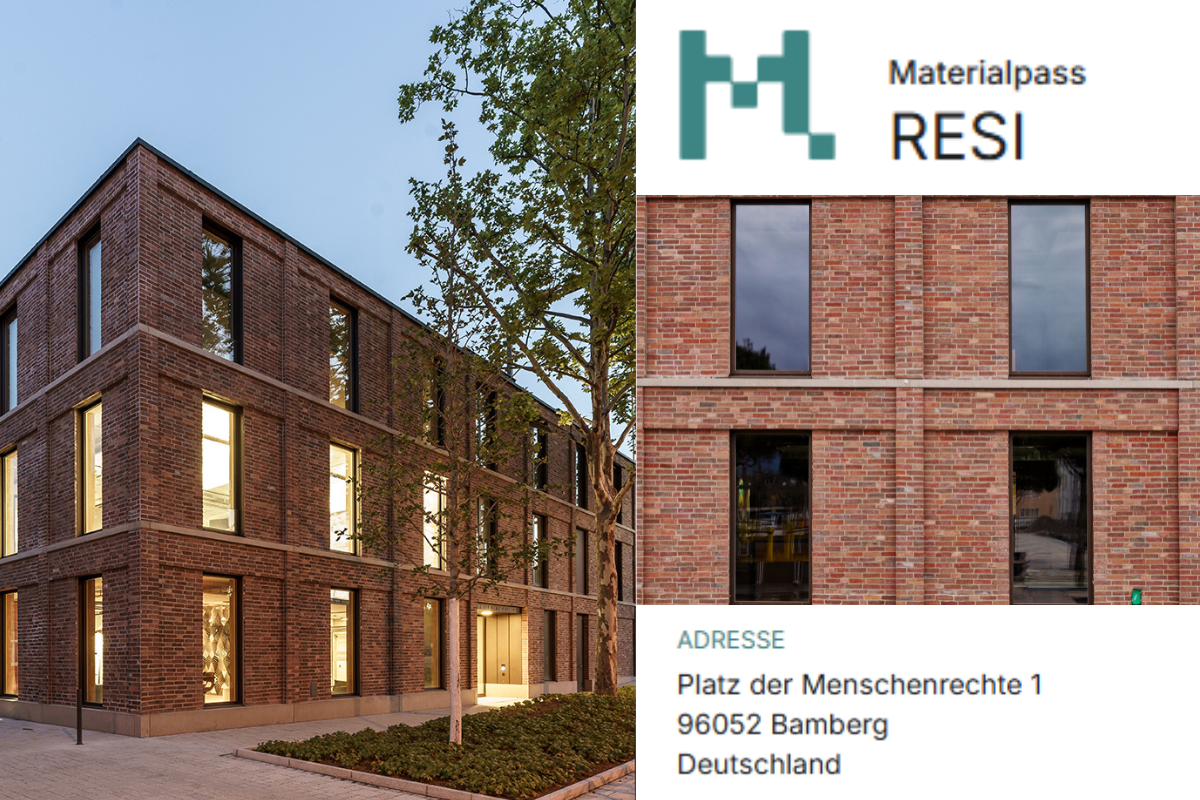
Why owners should act now – and what RESI in Bamberg is doing to set an example
The construction and real estate industry is facing a paradigm shift: away from the linear “take-make-waste” model and toward a circular construction industry. A key tool in this transition is the Building Resource Passport (GRP). It creates transparency regarding the origin of materials, recyclability, and demolition potential, thus forming an important basis for ESG and sustainability assessments.
But why should builders and owners go to this expense?
1. ESG, EU taxonomy, and DGNB: The GRP as a verification tool
The GRP has long been more than just a voluntary sustainability tool. In the DGNB 2023 system, it earns valuable points, it has been announced for the QNG system, and for the EU taxonomy, it serves as proof of compliance with environmental criteria. Institutional investors and companies with ESG commitments in particular benefit from the transparent documentation.
“We usually process building resource passports in connection with the EU taxonomy or subsidized projects according to QNG – the GRP is a decisive lever for resource conservation and value enhancement here,” reports Magdalena Gold, circular economy expert at Alpha IC and project manager for the creation of the building resource passport for RESI.
Studies by JLL and EY show*: ESG-compliant buildings achieve up to 10% higher market values. The GRP provides the necessary transparency for this. In addition, GRP is not only relevant from a regulatory perspective, but also makes economic sense: in new construction, the value of the materials used can be recognized in the balance sheet—and in demolition, up to 30% of costs can be saved because materials can be reused or sold rather than disposed of.
2. Urban mining: securing resources instead of wasting them
A GRP creates the basis for urban mining – i.e., the reuse of building materials during renovation or demolition. The better the material data is documented, the easier it is to recycle later. This not only saves resources but also reduces disposal costs.
3. Tools and systems: Madaster and alternatives
Alpha IC currently uses Madaster to create GRPs, but is open to other systems – provided that software licenses and project requirements allow this. It is important to note that the focus is on material transparency, not on the tool itself.
4. Practical example: RESI – sustainability begins with planning
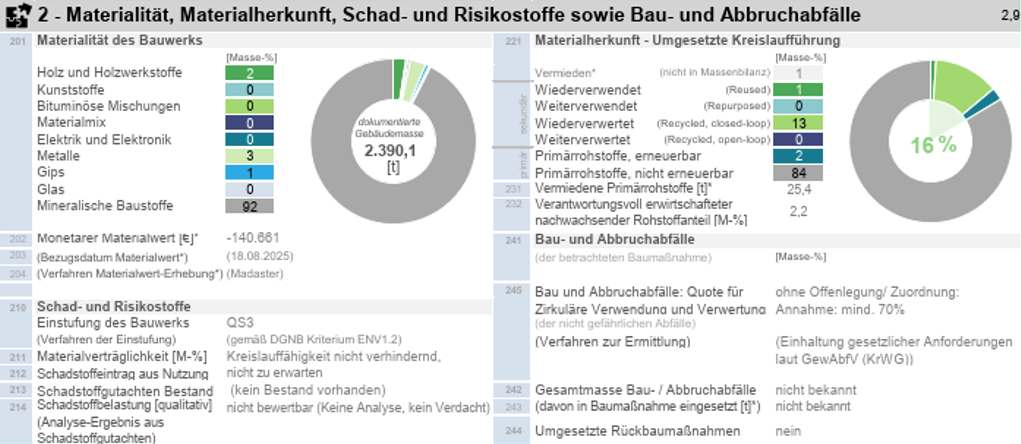
With the assistance of madaster, we also created a building resource passport in accordance with DGNB standards for our new RESI office building. This provided us with the following insights into our building:
- Recycled materials: A high proportion of mineral materials was deliberately used in RESI in order to be able to dispense with active heating and cooling systems thanks to thermal mass. This was already tested during the planning stage using simulation. However, conventional construction methods usually reduce the potential use of secondary and renewable raw materials. Nevertheless, the use of RC concrete in RESI saved over 200 tons of primary materials.
- Avoiding materials: The conscious avoidance of materials is also an important aspect of sustainability. At RESI, around 25 tons of material were saved by avoiding interior plaster and using exposed concrete surfaces. This aspect is also clearly shown in the building resource passport.
- Certified products: Even though only a small amount of wood was used in the RESI project, care was taken to ensure that the wood was sourced as responsibly as possible. This can be documented accordingly via appropriate seals (e.g., FSC) and seamless documentation on the construction site and is also relevant in building certification and the QNG seal, among other things.
- Dismantling and separability: Conventional construction methods have weaknesses in terms of dismantling, as is clearly shown in the building resource passport. Although removable carpet tiles were used in the project, for example, these have little noticeable impact on the assessment due to the mass-based evaluation. On the other hand, the material separability is positive, as predominantly monomaterial building materials were used. Nevertheless, glued layers and adhesions can severely limit actual recyclability, so a holistic view is crucial here.
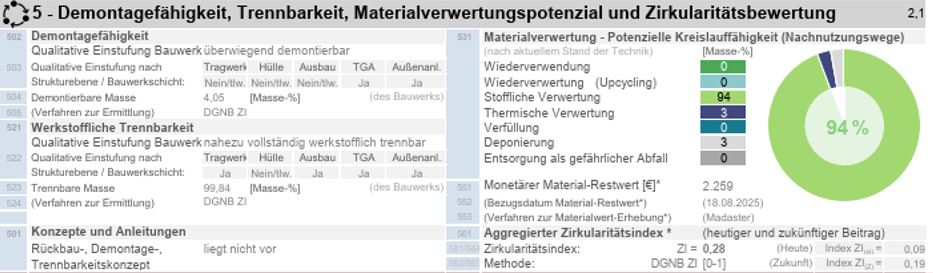
The creation of the building resource passport has shown that the earlier such documentation is implemented, the easier it is to implement. In the RESI project, the client's desire for a building resource passport was formulated at an early stage. However, the requirements were not clearly defined by the planning and construction team, so that in the end it was no longer possible to obtain sufficient documentation on the recycling rate of construction waste. “This experience shows that early implementation is crucial. The earlier in the project, the better the potential and necessary documentation can be commissioned and ensured,” is an important conclusion from the Alpha IC project team.
5. No industry benchmark yet
Currently, there is still a lack of industry benchmarks to make GRP values comparable. This is precisely why every documented project is an important contribution to the database. RESI is setting a good example by making qualities and key figures available in a transparent manner. Among other things, the project shows that small and medium-sized enterprises (SMEs) can also implement sustainable construction economically – at €2,164/m² gross floor area, construction costs were 16 percent below the BKI average for medium standards.
Conclusion: The GRP is not a nice-to-have – it's a must-have
Anyone who builds today must be able to dismantle tomorrow. The Building Resource Passport is the tool that helps owners, planners, and investors to act strategically, sustainably, and with an eye to the future. Alpha IC supports you in this – from the initial idea to the finished documentation. Contact us and make your project fit for the future.
*) https://www.jll.com/de-de/insights/dekarbonisierung-von-immobilien-verhilft-zu-wertsteigerungen; zugegriffen am 18.09.2025; https://www.ey.com/de_de/newsroom/2024/04/ey-esg-snapshot-2024; https://www.ey.com/de_de/insights/consulting/mit-zirkularitaet-mehrwerte-schaffen